Dare to Be Personal

by Catherine Ann Jones

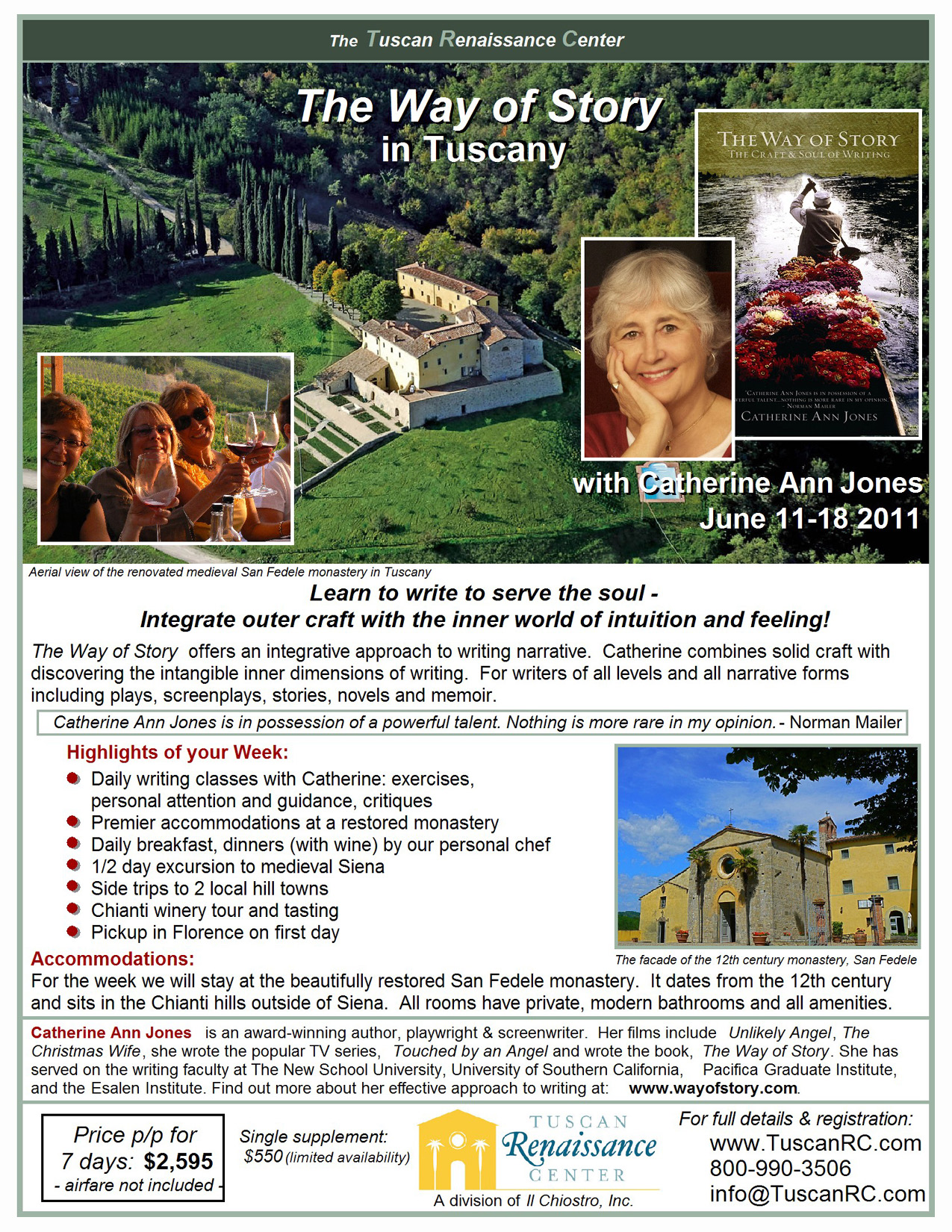
When television producer, Martha Williamson, asked me to write for her hit series, Touched by an Angel, I said I preferred to make up my original stories. So she asked me to make up a few and pitch them to her. She told me that if she did not like any of my stories, she would give me a story to write. I pitched nine original stories, and the one she chose for me to write first was the only one of the nine that was inspired by an incident from my own life. I was psychic as a child and would often tune out and listen to inner music, so my teacher thought I might be hard of hearing. This diagnosis began a series of doctors and examinations to find out what was wrong with me. Of course, nothing was wrong. I was simply creatively entering into my own world. So this was the starting point for what became the episode, A Joyful Noise. It is about a little girl who hears angels singing and is sent to a psychiatrist to rid her of her voices. In the end, it is the psychiatrist who is changed by the little girl and her angels. Olympia Dukakis plays an archangel in this episode. This was one of Oprah’s favorites -- she once screened a clip on her weekly television show. So, the moral is: dare to be personal.

What is the emotional personal thread from your own life which can be woven into your story? Answer this, and you will have the key to meaning for yourself as the writer as well as for the audience, who will identify with your feeling. It is no coincidence that the greatest novels and plays are often inspired by the author’s own family background. Eugene O’Neill’s Long Day Journey into Night, Tennessee Williams’ The Glass Menagerie, Boris Pasternak’s Dr. Zhivago, or Thomas Wolfe’s Look Homeward Angel are all examples of this form of inspiration. Consider fiction no more than disguised autobiography. It need not be literally autobiographical, of course, just emotional autobiographical.

Subjectivity is necessary for all great art. Story is no exception. I will go on record and say that subjective point of view from the writer as well as the subjective response of reader or audience is the most important aspect of any book or movie. This is why sometimes our favorite movies or books are not classics, but simply something we strongly identify with. They hit a nerve. A disaster film depicting a great love story, Titanic became the best selling movie of all time (before James Cameron went animation on us). One of my favorites is Anne of Green Gables about a little girl with too much imagination. Ask yourself what is your favorite book or movie, the one you like to return to, and it may surprise you that it may not be a great classic, but simply the book or movie you love. Craft without art: it works but who cares? The audience must care. Caring sells tickets. We care by identifying with the main character, something within must emotionally connect to our own life.

Once again, dare to be personal.


Catherine Ann Jones has played major roles in over fifty productions on and off-Broadway, as well as television (Great Performances, etc.) and film. Disappointed by the lack of good roles for women, she wrote a play about Virginia Woolf (On the Edge) which won a National Endowment for the Arts Award. Ten of her plays, including Calamity Jane (both play and musical) and The Women of Cedar Creek, have won several awards and are produced both in and out of New York. Her films include The Christmas Wife (Jason Robards & Julie Harris), Unlikely Angel (Dolly Parton), Angel Passing (Hume Cronyn & Teresa Wright) which played at Sundance and went on to garner fifteen awards here and abroad, and also the popular TV series, Touched by an Angel.  A Fulbright Scholar to India, she has taught writing at The New School University, University of Southern California, Pacifica Graduate Institute, and the Esalen and Omega Institutes. Ms. Jones is often invited as a keynote speaker to various conferences as Women, Wealth, & Wisdom Conference at UCLA. Ms. Jones lives in Ojai, California, leads The Way of Story and Heal Yourself with Writing workshops throughout the United States, Europe, and Asia. Her book The Way of Story: the craft & soul of writing is used by many schools, including NYU writing programs. For her workshop schedule, online courses, blog, and story/script consultant service please visit www.wayofstory.com.

Lessons from Ketchup

by Shelly Lowenkopf

Ever wondered how words are like ketchup? You haven't? How about a clue? It has nothing to do with the red sauce being America's favorite vegetable. Shelly Lowenkopf shares his insights, culinary and literary. Reprinted from inkbyte.com.

There are times when trying to get words out is like trying to shake ketchup out of the bottle in a truck stop restaurant. Words and ketchup have each congealed, requiring the firm hand of discipline, applied according to Newton's First Law of Motion, in a place where it will do the most good.

There are times when words and ketchup, having been set in motion, spill forth with an audible glop, sending more of each in a cascade toward the intended target.

There are times when the right amount of each commodity come forth in seemingly smooth flow, but these times are rare, at least with me, lingering not so much as goals or even memories but rather as abstracts, ideals to be sought after as the Holy Grail was sought after, as the Maltese falcon was sought after, as the philosopher's stone was dreamed of.

Much of the time there are no words or insufficient words, words ringing with insincerity or the metallic tang of ignorance, just as there are places where ketchup is not looked upon with favor, where the very mention of it is enough to produce wrinkles of facial disapproval or, worse, wrinkles of brows, suggesting ketchup is déclassé.

Not to forget the times where there are too many words, carrying their meaning and even their intent on a metaphoric journey demonstrated in fact by the appearance of too much ketchup on a steak or side of fries. Any amount of ketchup on eggs is an entirely more serious transgression in the eyes of many.

Some of us go through the warp and woof of our days, trying to keep the orderly movement of words and ketchup in some balance, some enough-but-not-too-much formula. The serious study of words is help, keeping a tendency toward too many or too few in a healthy presence. Thanks to fast food and convenience-food restaurants, small amounts of ketchup are stored in foil or plastic packets.

How many words are enough? How much ketchup on, say, an order of French fries is enough? How many words are required to cause the eyes of the listener to glaze over, a sure sign of surfeit? How much ketchup is enough to dress French fries or serve as an adjunct to a steak?

Words in proper combination and with proper delivery can selectively attract, repel, anger, embarrass, explain, entertain, inspire. Ketchup can season, splatter, stain, make gurgling noises; even worse, ketchup can disgust. A washed-out ketchup bottle can serve as an emergency bud vase. Washed-out words don't help much with anything.

We can come to terms with words, eventually, but there are those who will never come to terms with ketchup.

(Copyright 2011, Shelly Lowenkopf)

Richard Walter: Hollywood Trends—A Recipe for Frustration and Failure in the Movie Business

The biggest mistake a writer can make is to pay attention to Hollywood trends. By Richard Walter

What is the trend today in Hollywood?

I'm standing smack-dab in the middle of the town and haven't a clue. As in algebra, however, let's say that there is a trend and let's call that trend 'X'.

It's too late to get in on that trend for the simple reason that it is the trend. If it is the trend today, it had to be in the pipe at least a year ago, and much more likely two or three or more years ago. To cash in on that trend by writing a script geared to it is to guarantee that by the time you go to market it's already old news, stale, pale, and so last year.

During a strike years ago, since no one could market to the studios, a huge pile of spec scripts were written by writers, some of them well established. The idea was to have the scripts ready to sell after the strike. When the strike finally settled, there was a flood of cop-buddy police action melodramas, which appeared to be the trend at the time the strike started. Two writers well known to me and the community, however, a husband-wife writing team, wrote a spec script representing the kind of movie nobody was making at the time: a period piece, a historical costume drama. Happily for them, it stood out above the rash of police thrillers. It caught the imagination and attention of studios and producers first of all because it was not merely another cop action melodrama. It promptly sold for a substantial price. In the meantime, dozens, indeed scores, perhaps hundreds of cop thrillers went into the shredder.

Perhaps twenty years ago I advised my screenwriting seminar commandos at UCLA not to outsmart themselves by trying to figure out the latest trend. I suggested they write the dumbest script they could think of. At that time nobody was buying or making westerns, and so I advised them to write a western. When it was ready it would be the only such item and, therefore, attract attention.

One of the students took me up on this suggestion and wrote a hilarious comedy set in the American west after the Civil War. Not a gunslinger but a painter makes his way west, hauling a wagon of artist's supplies: canvases, tubes of pigment, linseed oil and turpentine, brushes, a pallet and the like. New towns are springing up across the landscape and each has a brand new saloon, and every saloon needs a naked lady above the bar. Our protagonist arrives in one town and then the next, paints a naked lady to hang above the bar, and in exchange receives room and board from the owner, plus provisions to enable him to continue his journey.

At one town the mayor is a Victorian-style prude, who doesn't think there should be pictures of naked ladies in the saloon or anywhere else. He is particularly disturbed by the portrait of the naked lady painted above the bar in his town, as she appears strikingly similar to his wife, right down to a wen in a particularly intimate spot on her body. One would have to know her very, very well indeed to know about that particular portion of her skin.

When the script was finished I referred it to a producer pal of mine who had made an iconic film reminiscent of this script. He read it immediately and promptly acquired the rights, though it was merely a low ball option--very little money--and only for a month. Many writers don't seem to understand that a short option is better than a long one. With a short option the writer gives away less. There's more pressure on the producer to--what else?--produce. Only the other day I overheard two writers bragging to each other about options they had sold. One was for six months. The second boasted that his was superior: a year. Talk about being unclear on the subject! It's like the old joke about Philadelphia. There's a contest; first prize is a week in Philadelphia; second prize is two weeks in Philadelphia.

The writer of the western was shown around Hollywood under the best circumstances. He was not shown around by himself: they wouldn't have read him. He was not shown around by his agent; he didn't have an agent. But even if he had an agent it's not as good as being shown around by a producer with a track record for making hit movies who wants to make your movie. This writer, therefore, was not read by underlings but by the heads of the studios. There's nothing wrong with being read by underlings, but there's also nothing wrong with being read by the chiefs.

At the end of the diminutive option period, nobody bought the script. The writer, however, had all the rights of the project revert to him, and he got to keep the option fee. What's not to like about that? More to the point however, during that brief month he had gone from being completely unknown to being very well known.

At one studio, while they didn't want to make his western, they loved his fresh, funny voice. They had an in-house script that they had not been able to get an A-list Hollywood writer to get a handle on, and so they decided to give him a shot at it. Since he was just rewriting somebody else's script, and he'd never had any professional writing work, they only paid him ten thousand dollars. A week. With a six week guarantee. It actually took eight weeks, so he walked away with $80K, not the kind of fortune it once represented, but certainly enough to buy guacamole to carry him through Cinco de Mayo.

If that's all that he got out of it, it's not a bad deal. But it's not all he got out of it. He also won representation. Imagine you're an unrepresented writer with a major studio wanting to pay you $10K a week for a rewrite assignment. Agents and managers will line up at your door and you can pick and choose. He chose wisely and has a substantial and sustained career under way now for many years.

All of this success accrued from what? Not from homing in on the latest 'trend' but by deliberately, purposefully bucking the trend, not by following the wise course but the dumb one.

From my perch in Westwood I cannot tell you how many times I see writers waste their talent and effort and energy by ignoring the story that's in their heart, the story they want to tell, and instead writing the story they think some producer or studio may want them to tell.

It is a self-defeating prophesy from the get-go.

Writers! Stop working in your heads and work in your hearts. Screenwriting success is not about thinking but feeling. If the writer herself doesn't truly care about what she is writing, why would any producer?

# # #

Follow Richard Walter on Facebook to stay in the “screenwriting know” by “liking” his fan page: www.facebook.com/richardwalterucla

About the Author: Richard Walter

Richard Walter is a celebrated storytelling guru, movie industry expert, and longtime chairman of UCLA’s legendary graduate program in screenwriting. A screenwriter and published novelist, his latest book, Essentials of Screenwriting, is available in stores now. Professor Walter lectures throughout North America and the world and serves as a court authorized expert in intellectual property litigation. For more information and to order the new Essentials of Screenwriting, visit www.richardwalter.com. Richard can be reached at rwalter@tft.ucla.edu.

Copyright ® 2011 Richard Walter

Striking Gold: A Copyeditor Can Make Your Manuscript Shine

by Catherine Viel

(First of two articles on copyediting. Reprinted from Ink Byte Magazine.)

What's the best way to choose a freelance editor? By asking the right questions and understanding the level of editing your manuscript needs. Once you've decided your book deserves the extra attention (and extra potential for sale), the true challenge is finding just the right copyeditor for you and your prose. Here's a place to start.

What is my budget? Expect to pay from below $1,000 to several thousand dollars to have your book edited. Pricing depends on many factors, including the length of the book, the amount and type of editing required, the overall condition and complexity of the manuscript, your expected turnaround time, and the experience of the editor. Seasoned copyeditors should be able to provide a time/cost estimate after seeing your manuscript, but don't expect to receive a firm bid if you can't supply a substantial sample (preferably the entire manuscript).

How soon does it need to be done? Many editors are booked up for weeks or months with multiple projects, so if you're on a tight deadline, this might be the first thing you should ask.

How much editing does my manuscript need? Make your best guess as to whether your book needs a light going-over for minor grammar and syntax issues and mechanics such as capitalization and hyphenation, or if it would benefit from a more analytical, content-focused approach. Ask your potential copyeditor to describe the levels of editing he provides and what he does for each level. This should be along the lines of light, medium, or heavy edit. Semantics vary in this profession, so make sure that if you want a line edit, your editor can explain what that means to him—and it agrees with what you want done. In the end, like it or not, your editor may determine that your manuscript needs a more detailed and time-consuming edit than you thought it did. That's why it is essential to get several bids on editing your manuscript. If three different editors tell you it needs a heavy edit that will take a month to accomplish, that's probably what it needs.

Is face time important to me, or am I comfortable with an all-electronic and phone relationship? Many freelance editors never see their author-clients, and excellent work is still accomplished. If you're in a smaller town or out-of-the-way locale, you may have no choice but to work via the Internet. If it is important to you, and you think there's a good chance you can find someone local to work with, give it a shot by searching the EFA database or even Craigslist (see resources at the end of this article).

Am I self-publishing or do I intend to submit to agents or publishers? If you're self-publishing, you have more leeway with making certain editorial decisions, though generally you'll want to follow the guidelines in the Chicago Manual of Style. If you plan to submit to an agent or publisher, ensuring that your editor is thoroughly versed in Chicago is essential. Wherever your manuscript is headed, partnering with a copyeditor who has the appropriate expertise and knowledge is of paramount importance to creating the most bulletproof book possible.

To sum up, to prepare for your copyeditor search: finish your manuscript, think about what your budget can handle, and figure out how much editing your manuscript needs. (The only time you won't need a complete manuscript is if you're looking for a developmental editor or ghostwriter, but that is a subject for another column.) Begin by emailing two or three copyeditors and describing the project particulars. When you talk to the candidates, have a list of questions, take notes during your conversation, and ask for bids. Perhaps most important of all, pay attention to your gut and gauge your comfort level with each candidate. You must feel you can trust your editor and can communicate freely and easily during the often lengthy process of having your book edited.

Last but not least, you're perfectly within your rights as a consumer to request a short sample edit from potential editors before making your decision.

Resources for finding copyeditors The Editorial Freelancers Association (EFA) (www.the-efa.org) and the Bay Area Editors' Forum (www.editorsforum.org) both have searchable listings of individual editors, and the EFA has a free job board you can submit your project to. (Be warned: you may receive literally hundreds of responses if you post to the JobList. Sometimes it's better to search the member database and contact several editors individually.) You can also check advertisements and listings in Writers Market online, the Writer magazine, Poets & Writers, and Writer's Digest. For the adventurous, there's Craigslist... look under writing/editing/translating services ("write/ed/tr8"). If you do find someone on Craigslist, it might be prudent to do a little checking into their bona fides. Most professional copyeditors maintain a website—ask your Craigslist candidate for their URL. Find out how many books they've edited, and request the titles and publishers of a couple of them. Membership in the EFA or another editorial organization, a college degree in English, journalism, or communications, a copyediting certificate from a legitimate provider (like a university), and/or relevant work experience should assuage any doubts. And of course, checking references is always a good idea.

Interested in a career as a copyeditor (or even just improving your self-editing skills)? Several institutions offer in-person and online classes and certificate programs, including UC Berkeley and UC San Diego. The Editorial Freelancers Association offers classes as well. For a thorough grounding in how to copyedit, read the text and do the exercises in The Copyeditor's Handbook by Amy Einsohn. Finally, an entire education in itself is to read all thousand-plus pages of the Chicago Manual of Style (get the newest edition, 16—or subscribe to the online version).

Learn more about this complex topic by exploring the extensive resources and FAQ pages on Catherine Viel's website, www.writecat.com. Or send her an email with your questions, writecat@cox.net. She'd love to hear from you and help you solve your copyediting conundrums.

Santa Barbara Literary Scene Dead? by Melinda Palacio

Gone are the downtown bookstores. We grumbled when two big Box bookstores moved to State and Carrillo. Barnes and Noble, then Borders, squeezed out the Earthling and forced the independent store out of business. The town took years to warm up to Borders, but we took advantage of the space with poetry open mics, book signings, musical and literary performances, and a meeting place for residents and writers. Apparently, these stores were big enough to fail. Soon, talk of bankruptcy replaced book talk.

The idea of being a respected author in Santa Barbara is also fading. Last year, after my eye exam, my optometrist asked me the usual questions. I told her about my various publishing credits and when I paid my bill, she called out, “Author in the House.” Her assistants turned over appointment books and scrolled through the computer’s database for a patient named Arthur. “Let me know about a future book signing,” her words trailed off. The optometrist is across the mall from a closed Borders.

Some might respond that we still have used bookstores left in Santa Barbara and independent, Chaucer’s Books. However, none of those well-meaning establishments has the downtown space for readings, meetings, or the coffee shop that big bad Borders had.

The book tour is another endangered dream as more readers buy books online. Why travel a thousand miles to read to a crowd who may not even buy your book when you can do a virtual tour? Unless you’re football star who has published a memoir or you’re a poet, outfitted by Oprah’s magazine team, the book signing audience will most likely consist only of writers who are supporting each other. Perhaps this is why the star-studded town of sleepy Santa Barbara has decided to allow the city’s Book and Author Fair to be canceled, with no one stepping up to show that the town values authors and their work.

The internet cannot adequately replace the experience of a book signing and discussion with a handful of people, willing to weather a rainstorm. Daniel Olivas reminds us of the importance of connecting with readers:

“As I’ve noted before, writing is a lonely endeavor, but when I get to participate in book readings, the loneliness dissipates and I am reminded why I write. That personal connection with readers fills me with energy and inspiration…I wouldn’t write another word if I couldn’t participate in such literary events.”

The roles of agents and publishers are being challenged thanks to the virtual store that cannot be contained: Amazon. Anyone can publish and sell a book on Amazon and a lucky few, such as 26-year-old Amanda Hocking, are making millions. Santa Barbara literary agent, Toni Lopopolo has her own view of these changes:

“Well written novels, at least those with a good story, get published, not self-published. What I do like is that smaller publishers are springing up who publish a limited number of books each season. Some of them have great business plans and put their major efforts into marketing. You don’t get that with the major publishers unless you receive a large advance.”

There are many writers in this town who keep trudging away at their craft, even though they realize that book advances and seeing their names in print, may be a dream.

After an absence of two years, the Santa Barbara Writers Conference starts up again, June-18-23, and this year, Bilingual Press will publish my novel, Ocotillo Dreams, this Summer. April is National Poetry Month. Santa Barbara shows there’s life in the local literary scene by electing a new city poet laureate, Paul Willis, and by hosting poetry events throughout the month. I will host a free reading by the Santa Barbara Sunday Poets April 23 at the Karpeles Manuscript Library from 3-5pm, 21 W Anapamu Street.

Melinda Palacio's debut novel Ocotillo Dreams will be out this July. This post first appeared on La Bloga. For more by Melinda Palacio, visit her website.

Diana Raab Blogs: Beginning your Memoir

Often times people write memoir to try to come to terms with an event in their lives. For many people this type of writing is both cathartic and healing. There are numerous ways to begin thinking about writing your memoir, but one idea is to start thinking about what aspect of your life you would like to write about. To help with this decision, here are some questions to consider:

1) What’s going through your head?

2) Who are your villains? Who are your heroes?

3) What are you obsessed by?

4) What inspires you?

Keep in mind that many published writers say their best story ideas come to them when they’re not sitting at their desk ‘working,’ but rather when they’re simply living life. It is therefore important to remain alert to those special moments in your everyday life. This is why I suggest that all writers carry a notebook or journal. You just never know when an idea will strike. It might be while you are reading the daily news, when you have a conversation with a loved one or friend or when you are driving down the freeway and have to pull aside to write.

Remember, the creative life is a journey in that it is unpredictable, unstructured, mysterious and laden with miracles. There is no time like the present to begin. So crack open your notebook and write about the first thing that pops into your head!

Hope to see you in June where I will help you shape some of your ideas into a working structure for your memoir.

**

Now is the best time to start thinking about your memoir. Why? Because:

1)    April is Stress Awareness Month

2)    May is Mental Health Awareness Month

3)    Writing memoir is often about writing for healing

4)    To prepare for my workshop “From Journal to Memoir”

by Diana M. Raab, MFA, RN

http://www.dianaraab.com/


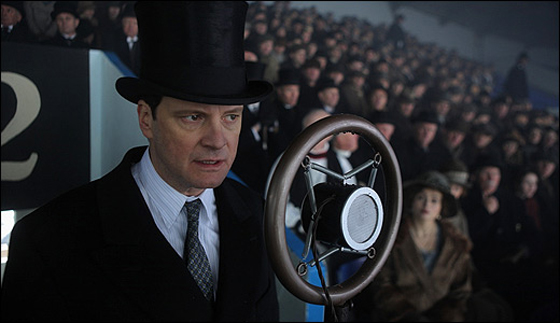
Catherine Ann Jones Blogs: Why The King’s Speech won the Oscar?

This is my first year not to vote for either the Oscars or the Emmys simply because I did not pay dues this year. In order to vote, I had wearied of seeing the Hollywood contenders, for the shows I wished to see were fewer and fewer these past years.However, this year there were at least two fine films: The King’s Speech and Winter Bones. One was from England and the latter, a small independent American film. Where is Hollywood? Making blockbusters, of course.

Yet I want to speak on why The King’s Speech was a predictable winner this year. Of course, it is a well-structured screenplay with a fine cast and director, this goes without saying. There are some other points which may interest writers though.

1) Like Seabiscuit (novel & later Oscar-nominated film), Laura Hillenbrand infused her story with the conflict in her own life, i.e., her challenge of living with chronic fatigue syndrome. All three of her characters had to overcome great obstacles – and the horse, too. Similarly, The King’s Speech, written first as a play by an unknown David Seidler, was infused with his lifelong struggle as a stutterer. This gave the character emotional power. So the moral is dare to be personal. If not, the details of your own life, then make your story emotionally autobiographical.

2) The well-structured story set in WW II England had a myriad of plotlines as the backstory such as Hitler, WWII, abdication of the King and a new King reluctantly taking the crown, etc., yet the dramatic story was singularly focused about a man who would be king lacking self-confidence whose stuttering is the main symptom.

3) The conflict and dramatic action is singularly focused between two characters, the speech therapist and the soon to be King of England. As Aristotle knew, this singular focus of theme and time and place creates great drama.

4) The main character, splendidly played by Oscar winner Colin Firth, was written with a wide transformational arc. That is, he began as a shy, terrified man who was transformed by the relationship with his speech therapist/friend into a confident and strong monarch.

5) A protagonist with a tragic flaw or imperfection is one everyone can identify with. So the moral is dare to be personal, write about what you feel strongly about, write a three-dimensional character-driven focused story with a clear thematic thru-line.

Catherine Ann Jones www.wayofstory.com

ViVACE Literary Journal Calls for Submissions

ViVACE Literary Journal: A selected collection of poetry, prose,  art/photography. Published semi-annually. Available through book dealer websites i.e. Amazon.com; major bookstore inventory requests and from the Managing Editor.

SUBMISSION DIRECTIVES

Deadline: May 28, 2011

Please adhere to the following guidelines.

1. All potential contributing writers are kindly requested to subscribe to ViVACE. For subscription information, email vivacemg@gmail.com .

2. You may send, via email vivacemg@gmail.com , up to three unpublished poems or two 1,000-word fiction written in Microsoft Word. We do not  read simultaneous submissions.

3. Include your name, address and phone number at the beginning of each submitted email attachment. Submissions without this information will not be considered.

Memorial Service to Honor Anne Lowenkopf

RENOWNED AUTHOR, EDITOR, AND SBCC INSTRUCTOR SANTA BARBARA, CALIF.

A memorial gathering honoring Anne N. Lowenkopf, a nationally recognized writer and editor who taught at Santa Barbara City College, will take place at the SBCC Schott Center Auditorium at 2:00 p.m. on Sunday, February 13. Lowenkopf, 83, passed away on December 7, 2010 following a brief battle with cancer. Lowenkopf taught writing and literature courses at SBCC in the Continuing Education program for more than 30 years. She is remembered by students, colleagues, and friends for her intellect, wit, enthusiasm, and generous spirit. A permanent plaque in appreciation of her teaching skills was installed at the SBCC Schott Center in 1990. Her passion for gardening, dogs, and the expression “hooray” was renowned.

Copies of AnneThology, a collection of writing by Lowenkopf’s students, will be available at the memorial. She said the best gift her students could give her is to write, and this compilation was presented to her prior to her death. The book includes writing tips and a foreword written by her husband, noted educator, author and editor Shelly Lowenkopf. AnneThology will be available for $20 at the memorial and the Schott Center office. All proceeds go to the SBCC Anne Lowenkopf Honorary Fund.

Lowenkopf’s editorial talents were honed as a researcher and copy editor for a trade book publisher in Los Angeles. Frequently retained by established authors as an editor, ghost writer, or story consultant, her own publishing profile includes articles and books on history, mysticism, travel, writing, Native American religion, and anthropology.

Of the many books she wrote, Camping with the Indians (Sherbourne Press) was one of her favorites. An avid backpacker and hiker, Lowenkopf set off for the Southwest in a borrowed VW van with her Bluetick Coonhound named Jedediah Smith. The resulting work was lauded not only as a valuable backcountry guidebook but also as an enjoyable literary read that offered a keen sense of culture, place, and people.

Lowenkopf was born in Minneapolis, Minnesota and grew up in the Los Angeles area. She studied anthropology at the University of California, Berkeley and graduated from the University of California, Los Angeles with a Bachelor’s of Art in English and a minor in Anthropology. She completed graduate work at California State College, Long Beach in the Psychology Ph.D. program before focusing on writing and editing. Lowenkopf spent three years as a Vedanta novice nun and studied with Swami Prabhavananda, who founded the Vedanta Society of Southern California in Hollywood in 1934. She maintained close ties to the Vedanta Temple in Santa Barbara throughout her life.

She was a committed teacher and taught her last class four weeks before her death in Santa Barbara. She once remarked, “Human beings are complex bundles of mysteries. Even when I get to the end, I still won’t know everything about myself, but I’m enjoying the exploration.” Students have remarked Lowenkopf’s enthusiasm for life powered her teaching and that she guided them to feel a part of something larger than themselves through reading and writing.

More information about the Anne Lowenkopf memorial and AnneThology can be found at www.sbannethology.com or via email at annethology@yahoo.com.

Sid Stebel Blogs: Ray Bradbury & SBWC Beginnings

Many years ago, 1948 to be exact, while a disaffected English Lit major at USC,  I became more than a little depressed when I was invited to join an off campus student writers’ group who called themselves THE BARDS. The Bards wanted to publish a literary quarterly. They asked me to be the magazine’s editor. (Though I was a WWII vet with enough combat experience to know that to survive one must NEVER UNDER ANY CIRCUMSTANCES WHATEVER VOLUNTEER!),  I found myself unable to turn down a job that came with such an imposing title, and with $60 in my pocket monthly (from the GI Bill) never minded  that there was no salary.)

During the organizational meeting, a fellow Bard suggested we needed a ‘name’ writer to bring attention to our magazine. Be great if anyone actually knew one, I responded.  We know Ray Bradbury, another Bard answered. Who’s he? I asked…and indeed unless you were a Sci-Fi fan (I wasn’t, Crime & Punishment was my bible) you’d not likely guess that this jolly fellow would eventually become the now internationally celebrated author of such classics as The Martian Chronicles, The Illustrated Man, & Fahrenheit 451.  We went to Bradbury’s tiny house set alongside a Venice canal (his only connection to the outside world was a pay phone in a booth under a street light), and he graciously agreed to give us a story. It fell to me to re-type Ray’s manuscript into a printer-ready format  – and I have always felt that a smidge of Ray’s vast talent came up through my fingertips and into my brain – my only explanation for why the many rejection slips I was receiving – heretofore anonymous – began taking on a friendlier tone. (The Bard’s COPY Magazine, meanwhile, was launched, and received a front page illustrated review in the Sunday NY Times Book Review.) Ray and I became fast friends, and he asked, indeed demanded, to read my short stories and novel-in-progress – which, under his benign aegis, took on a more accessible (read: professional) tone.  In time Ray, too nearsighted to drive himself, asked me to chauffeur him to many of the book events at which he was the featured speaker.  One of those events was the Squaw Valley Writers Conference, where we met Barnaby Conrad, a legendary figure renowned for having been gored fighting a bull (research for his best-selling novel, MATADOR.)  Barny informed us he was thinking of starting a Writers Conference in Santa Barbara, and asked Ray to become his keynote speaker.  Ray agreed, then convinced Barny (based on his knowledge of my writings & my critical commentaries when at his behest I joined his own writing group) that I would be an asset to his Conference as a Fiction Workshop Leader.

Thus was born the very first SBWC, held at the nearby Cate School (one of whose alums is Monte Schulz.)  With Barnaby Conrad, Jack Leggett (a future Director of the Iowa MFA Writing Program), Nils Mortenson, one of Barnaby’s many writer friends, and myself as workshop leaders, and Ray Bradbury as the keynote (read: inspirational!) speaker, the Conference was judged a success – not least because of the organizational efforts of Mary Conrad, Barnaby’s indefatigable wife.

Since then, I have conducted a workshop at every Conference meeting since, save one  – and want to echo our Conference’s savior Monte’s thought that the most basic (and enduring) value of the Conference is its ‘vibe’…that is, the interaction of all those attending which, in creating an almost audible ‘buzz ‘ , provides the kind of turn-on no drink or drug can equal. Ask any writer who attended during those early formative years.

Barnaby never missed an opportunity to remind everyone that in addition to the auras of famous authors that we all basked in, it was the workshops which provided the most tangible benefits to those attending. Who would disagree?  In the give and take of workshops Reads & Critiques only those unwilling to open minds or hearts did not benefit from the discussion.

This also benefits – it may surprise some to hear - Workshop Leaders.  In the dedication page of my writing book, “Double Your Creative Power!”,  I thank those who attended my workshops for providing a kind of writing laboratory in which we,  writers all, struggled to discover those verities which could transform our own writings into works of substance and art.

This writing book might never have been written had I not received – at a Conference more than a decade ago -a very tangible gift from a woman who had attended every session of my workshop during the week. On the last day she handed me a sheaf of papers, telling me that they were the extensive notes she’d taken of everything I had said in response to questions about fiction that had been raised during our ongoing Read & Critiques. Reading those pages later I was stunned to discover that they formed the basic elements of the book about writing I’d always wanted to write “when I got around to it.”

If not a movable feast, I hope it at least proves to be a bountiful one.

Note:  This coming June at SBWC 2011 I’ll be conducting intensive morning Fiction workshops about “Finding Your Secret Story.” The writing tips on my website, “Reprising a few fundamentals,” are hard won insights resulting from the nearly five decades I’ve spent conducting workshops  - and which are explored in greater detail in my writing text, DOUBLE  YOUR CREATIVE POWER!, now being used in writing programs at USC and NYU.

For more information, please visit my website at: www.slstebel.com .

Write on!

Gayle Lynds on The Villain!

Last week Monte and I had the pleasure of attending the Screenwriters Association of Santa Barbara meeting at Borders in Goleta, where bestselling author Gayle Lynds spoke.

Most interesting were Gayle’s thoughts on the Villain! Here’s what she had to say:

-Equally important to the hero is the villain. Your hero must have a worthy opponent. It creates marvelous friction. Sparks!

-Don’t make fun of your villain. It makes him less credible. If the author doesn’t believe in him, why should the reader?

-The villain perceives himself as an admirable person; he deserves what he’s after.

-Often at the beginning of the book, the villain is active and the hero is reacting.

-Give the villain at least one good characteristic. Ex. Adolf Hitler is the most hated person in history. He’s a monster—an aberration! The reader cannot relate to monsters. But when you learn that Hitler loved animals, suddenly he is humanized. You have something in common with him, and that becomes more interesting.

Gayle promised me she would blog about having met her late husband, author Dennis Lynds, at the conference. Please comment and convince Gayle to write a blog!

Gayle’s latest book, The Book of Spies, is out now. More about her at: http://www.gaylelynds.com/

Marla Miller Blogs - SBWC 2011: Full Circle

The year was 1972. Literary luminary Barnaby Conrad and his wife Mary had this notion for a writer’s conference. Barny got on the phone to friends Ray Bradbury and Alex Haley while Mary searched the area looking for just the right location. Though he loved the idea of a writer’s conference, Haley told Barny his schedule wouldn’t permit one more engagement. When Barny called Ray Bradbury, he essentially said the same. That’s when Barny dropped Haley’s name into their conversation. It would be years before Barny admitted that he might have given his friend the impression that Alex Haley had agreed to attend when in fact he hadn’t. Whatever the reason, once Bradbury heard that Haley was attending, he promised Barny he’d be there, too. Barny hung up from Bradbury, redialed Haley and intimated Bradbury would attend. “Then so will I,” said Alex Haley. With a solid lineup of literary stars to attract students, Mary found the perfect home at the Cate School in Carpinteria. SBWC enjoyed several years on that hill until we outgrew the campus. Mary went looking again and found SBWC’s new home just down the road in Montecito. The blue tiled Miramar Hotel would host SBWC for the next 28 years. If walls could talk, the stories they’d tell. Ray Bradbury, always dressed for tennis, almost daily could be spotted strolling along the multicolored flower lined pathways with tennis bag in hand. Barny’s morning workshop was standing room only. The Conrad’s Monday night cocktail party was the invitation to snag. Santa Barbara notables Robert Mitchum, Sander Vanocer and Eva Marie Saint mingled with workshop leaders and the ‘chosen few’ students lucky enough to be invited. Jonathan Winters doing stand-up in the Conrad’s living room added to our good time.

Change is inevitable and over the years, SBWC has gone through some. When the Miramar sold, we lost our home and moved back up the hill, this time to Westmont College. Another change took place that resulted in one more move; back down the hill to the Fess Parker DoubleTree Hotel & Resort. Not long after that move, the conference hit hard times and went on hiatus. For a while we didn’t know if the ‘granddaddy’ of writers conferences would ever be revived. Enter Monte Schulz, son of Charles Schulz who was as much a fixture at SBWC as Ray Bradbury. Like so many writers, Monte found his ‘tribe’ at SBWC, first as a writer on the road to publication and then a published author teaching SBWC workshops.

My path, like that of many SBWC workshop leaders, parallels Monte’s. In 1989, I attended my first SBWC, nervous and intimidated but not for long. With the support of SBWC, I became a published author during these years. In 2003, Mary Conrad said YES to my Marketing the Muse proposal. I’ve been teaching MarketingtheMuse Workshops ever since.

SBWC is back to our roots. Though Alex Haley and Charles Schulz won’t be there in person, in spirit they sure will. Ray Bradbury will do what he’s done since conference #1, deliver the opening night keynote. If you’re a new SBWC writer, brace yourself for a transformative experience and to all SBWC veteran writers, welcome home.

Marla Miller’s MarketingtheMuse curriculum offers writers FREE quick query critiques, noted author interviews & more through her website, www.MarlaMiller.com.

Happy New Year

I thought about the best books I read in 2010. Two came to mind: Humboldt’s Gift by Saul Bellow, and Tender is the Night by F. Scott Fitzgerald. They were so good I followed up with Bellow’s, A Theft, and Fitzgerald’s, The Great Gatsby, which I hadn’t read since high school and discovered there was much to be appreciated on my second trip to West Egg. The scene in which Daisy and Gatsby are reunited over tea at Nick Carraway’s house is a gem! The lexicon of those great writers is something I’ve found to be very rare amongst writers today. I edited my novel this year using Fitzgerald as a thesaurus. Some examples of his interesting and beautiful language: “Mrs. Speer’s consciousness was still clogged with sleep…” “The hotel crouched amid tumult, chaos and darkness.” “Already he could feel her absence from these skies: on the beach he could only remember the sun-torn flesh of her shoulder; at Tarmes he crushed out her footprints as he crossed the garden…”

On my list for 2011 are The Adventures of Augie March and This Side of Paradise.

What did you read in 2010?

What are you looking forward to reading in 2011?

Jane St. Clair Blogs About her First SBWC

Full CircleJane St. Clair

In June of 1992 I pulled into the Miramar in my '81 Datsun hatchback. I’d just graduated from CalArts and this was the first stop out of that creative hothouse, after three years of holy uninterrupted work. I’d sent a VHS copy (yes, it was that long ago) of the musical that was my master’s thesis and Mary Conrad wrote back with a scholarship invitation, courtesy of Robert Fulghum in honor of his retired fictitious secretary, Emily Phipps. When I met Mary in the registration line late that afternoon, I wished I’d dressed for the occasion. Because this woman was put together. If Lauren Bacall were to have a savvy sister in To Have and Have Not, it would have been Mary. She exuded an offhanded elegance that made me want to run change out of my shorts into something nice for dinner. And to further her rank, she treated me like gold. She brought me into the fold with a name tag and congratulations and introductions to teachers and students all around. I masked my terror of large groups with a cheerful face, which she saw right through as she put her arm around me, nodded to the mayhem and smiled.

“Thank you—” I began. “Have fun,” she said. Barnaby took my hand, almost as an afterthought: relaxed in his linen shirt and killer hat, as if to say, ‘Don’t sweat it, kid.’

That first night Ray Bradbury reminded me that it was my birthright and privilege to witness and celebrate with words on the page — and to never give up. But it was the first dark morning after midnight that set the tone for the next 18 years to come. Little did I suspect it at the time as I sat in the basement of the Conference building, with Shelly Lowenkopf presiding over his Pirate Workshop. I listened with an insatiable appetite for the well-told story and was not disappointed. This was the opposite of AA: this was Story Central, with a room full of insomniacs. A handful of them have since become family. When it was my turn to read that first time, I felt the room gather around me. That same morning and some little time before sunrise, Monte Schulz introduced himself and asked to see the pages I’d brought. He read them and walked me across the parking lot with his characteristic fifth-gear vigor and filled me in on his latest chapter, favorite writers and then asked me how much of this one or that one I’d read. This was a magic time that began that June and continued for a handful of years until the Miramar was sold. The stories, chapters and scenes read during Shelly’s Pirate workshops are still with me: Yvonne Nelson Perry, Jean Harfenist, Marianne Dougherty, Monte, Carmen Madden, Catherine Ryan Hyde — each took a turn at the podium and the sense of homecoming for me was palpable and electric. And lunchtime, as I downed an extra large coffee in the bright sunlight at the Boxcar Cafe, I felt like Dorothy when she woke to the black-and-white world and looked around to all the familiar faces: “And you were there. And you...and you!” Waves were breaking outside my window and my heroes were speaking after dinner: William Styron, the elder statesmen of truth and risk who woke the sleepwalkers with his elegant prose; I remember walking behind him, en route to the dinner late one afternoon, too smitten to speak. This is now a big regret. Charles M. Schulz, who gave me, a once blanket-toting toddler and often bossy little girl, the green light to be exactly who I was. I heard him speak in the Conference room several times over the years. One night he came into the Pirate workshop and there was an empty chair beside me on the last row, where he sat as Monte read from his big book, Crossing Eden, long before it turned into three novels. He smiled when Monte finished reading and I saw it and counted another conference moment I’d pocket for treasure.

Fast forward to this last June and Monte is at the head of a long table in the conference room of the Mar Monte hotel, telling all the workshop leaders there that the Santa Barbara Writers Conference is not something he chose to take on out of anything more than a wish: that it not die. Monte, in his rough-coat bravado, was speaking in a few sentences to what it is I’ve spent two long paragraphs on here. I’m sure he has his own reserve of moments that have informed this decision, but never mind, because just at that moment, in they come: Barnaby and Mary, characteristic elegance in legato now, as Barnaby’s ensemble now includes a cane to go with the hat, a cane that no doubt carries its own short story. They cross the room to applause, subdued panache unchanged.

“How’s everything?” I ask Mary after the group breaks up to tour the rooms for the upcoming June conference. “Good. Barney’s just out of surgery.” “He looks good,” I say. And he does. “How are you?” Not one to bow to sentiment, she returns with a line to do Bacall proud. “Well, I don’t have to worry about your scholarships anymore.” Scholarships that she processed for many years to come after that first summer at the Miramar. She smiles when I laugh. “Thank you.” And I say it again when Barnaby takes my hand.

Jane St. Clair is a published poet and songwriter, living in Santa Monica and Santa Barbara. http://www.janestclair.com/

Middle Grade Writer Gives Writing Tips

Monte's twins loved Matt Myklusch's first book, Jack Blank and the Imagine Nation. I like his tip about writing for YOU. Here is the posting from: "Guide to Literary Agents" This installment is from middle grade series writer Matt Myklusch. ??

Matt Myklusch spends his days working for mtvU, MTV's 24-hour college network. A lifelong love of comic books spurred him to spend his nights and weekends writing Jack Blank and the Imagine Nation, the first in a middle grade adventure series from Simon & Schuster, Aladdin. Matt lives in New Jersey with his wife and family.

1. You only fail if you quit. Don’t think about the odds and don’t give up. If you’re still trying to get published and haven’t quit, then you haven’t failed, no matter how long you’ve been at it A screenwriter named Josh Olson wrote, “You can’t discourage a writer. If I can talk you out of being a writer, then you’re not a writer.” I totally agree. Life is going to present you with no shortage of excuses for giving up. The important thing to remember is that’s all they are— excuses. They’re not reasons. Have faith in yourself and your story. You can do anything if you want it bad enough.

2. You’ve gotta really want it. If you want writing to be your job one day, you have to treat it like a job now. Don’t try to find the time to write… make the time. I know it’s not easy. You probably have a job, schoolwork, a family… maybe all three. Whatever your situation is, I’m sure you have a million things in your life that will keep you from writing. I’ve been there. I’m still there. But, there are 24 hours in every day. Last year, I started getting up at 5 a.m. every morning so I could write for at least an hour before work. All those hours eventually added up to a finished novel. You just have to make the time and push on through. If you can do it on less than ten cups of coffee a day, you’re doing better than me.

3. Write for YOU. Scheduling difficulties aside, writing shouldn’t all be such hard work. I don’t want to focus too much on that side of things. No one is forcing you to sit down and write except you, so write for yourself. Write the story that you want to read. The one that you’ll have the most fun writing. It takes a long time to write a novel, and if nothing ever happens with whatever you are working on right now, you better at least have fun writing it. That’s what I did with JACK BLANK, and I think it made a huge difference in how the story came out. It certainly made those early mornings a lot easier.

4. Writing isn’t just typing. It goes on all day. I find that if I am stuck on something and really push myself to think of an idea or solve a plot problem, I can usually come up with something pretty mediocre. But, if I let the story sit in the back of my head percolating long enough, eventually, something clicks. Make sure that part of your brain is always on.

5. Get to know your characters. Your characters drive your story, so if you’re not sure what comes next, sometimes you have to get to know your characters a little better. Tom Clancy once said in an interview how he planned to kill a character in one of his books, but then, at one point in the story, the character did something so interesting that he had to change his plans. When I first heard that, I thought, “This guy’s crazy. The character did something interesting? He decides what the characters do.”

But, Tom Clancy was right. If you really get to know your characters, they can surprise you. Get to know them before you start writing. What do your characters want? What are they afraid of? What have they been through in life that makes them who they are? All of this information might not even make it into your actual story, but if you know these things about your characters, then you’ll know what they would do in any given situation. You’ll know what each individual character would say and how they would say it.

6. Stay off the internet! If you’re writing, don’t let yourself click over to your email, twitter, or any other site you usually hit up. It will kill your productivity. Case in point, I checked the Yankees pitch-by-pitch on MLB Gameday four-hundred times while writing this post, and it has taken way longer than it should have. (The good news is, the Yankees won). But seriously, don’t let yourself take little breaks to check your email or anything else while you’re working. Let your writing time be writing time.

7. Don’t be afraid to dream big. Get your hopes up. That’s what hope is for. If things don’t work out with your current manuscript, that’s okay… take a day to feel bad about it and then keep moving forward. See item number one for additional details.

Agent Jon Sternfeld On: 5 Elements of Interesting Narrative Nonfiction (and Memoirs)

From: Guide to Literary Agents Jon Sternfeld is an agent with the Irene Goodman Literary Agency representing literary fiction (including well-researched dramas and historical thrillers) and narrative nonfiction that deals with historical, social, or cultural issues. He is open to all writers with an original voice and he has a particular interest in fiction that has a large, ambitious canvas (exploring a time, place, or culture).

Jon’s co-agent, Irene Goodman, offers manuscript critiques on eBay every month, starting on the first day of each month, with all proceeds going to charity. Click on the link for more details on these critiques and charity auctions.

Narrative nonfiction is a difficult and crowded market. Here are some thoughts about distinguishing your work from the pack.

1. Arcs: Like a strong novel, make sure the story and the main character have Narrative Arcs—that is each needs to go somewhere. Finding the arc is key or else the story is a jumble of disjointed vignettes that lead nowhere. Evolution of character and movement of the story make a true story as engaging to read as a novel.

2. Inverse Rule for Nonfiction: The less well known the subject/story, the more blow people out of the water amazing the story needs to be. This holds for memoirs the most—unless your name is a brand, your life story needs to be fresh, original, and surprising to have any chance in the memoir market.

3. Familiar Strange, Strange Familiar: As my creative writing professors once said, the key to tackling a subject is to make the familiar strange and the strange familiar. Surprise readers with what they thought they knew; show them the commonalities between their world and the (seemingly) strange world of your book.

4. Big and Small: My favorite nonfiction authors (Mary Roach, David Grann, Alain de Botton) intuitively understand this concept. The approach to their stories is “big” in the sense that there’s universality and larger implications (historical, social, scientific) in their work; the approach is also “small” in the sense that they get into the nitty-gritty details of their world: the fascinating hows and thought-provoking whys.

5. Voice: Remember that you, as writer, are a character in the book: If not in actuality (as in Erik Larson books and other historical narratives) then in voice. Nonfiction books these days are very ‘voice driven’ I hear this all the time from editors: THE VOICE NEEDS TO GRAB ME. Some books require an invisible hand, but unless your subject demands your objectivity/invisibility, put yourself into the story—either as a character, or at least as a perspective/voice. Your voice needs to come through.

Questions to ask yourself to see if a true story can work as a full narrative nonfiction book: Is there a hero, or at least an identifiable protagonist—someone we care about and relate to? Does this character have an arc? Does he/she evolve at all? Are there enough conflict(s)—plural—to keep the reader engaged throughout? Does it go and end up somewhere new and hopefully, unexpected? Is there a universality to the subject—as in, will people care? If it’s a story about an adoption gone wrong, do you get us to care about the problem, identify with the people, and see the larger issues at stake?

Final note on narrative nonfiction: Consider studying fiction narratives for what works in story and how that might be useful in nonfiction—all writers can be teaching tools so remember to look everywhere for lessons.